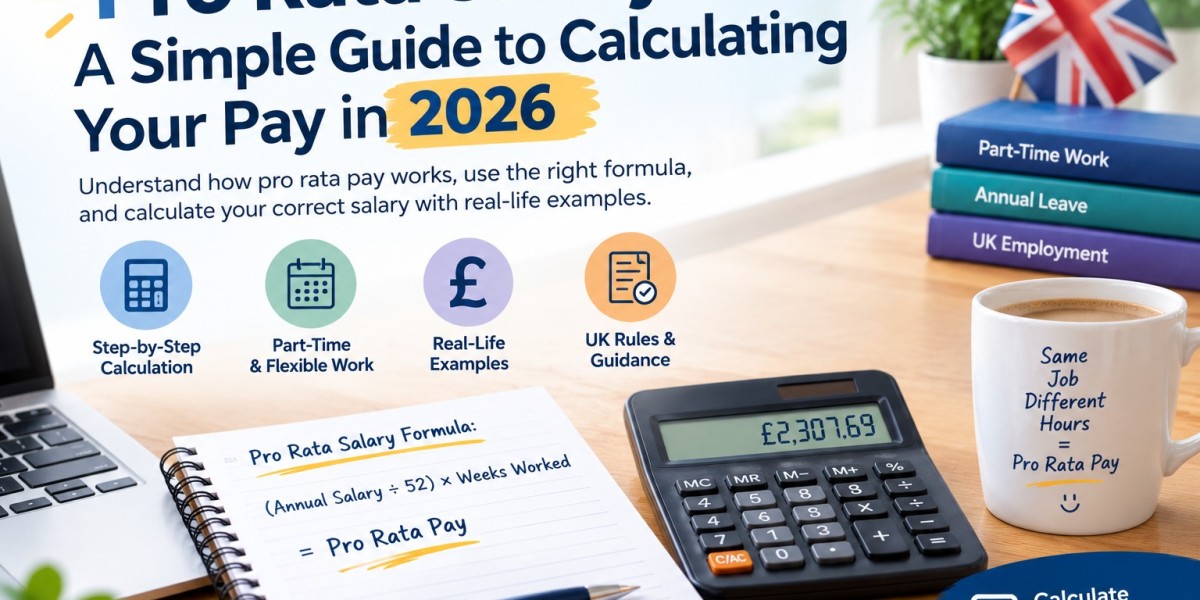

Are you starting a part-time job and wondering how much you should earn each year? Understanding your salary helps you compare job offers, plan your monthly budget, and check whether your employer is paying you correctly. A pro rata salary is calculated according to the proportion of full-time hours you work or the relevant period of employment. In this guide, you will learn how to calculate your pay using simple UK examples and a practical formula. By the end, you will understand how to check your expected earnings.
What Is Pro Rata Salary in the UK?
Pro rata salary refers to a proportion of a full-time annual salary based on the hours an employee works. Employers commonly use this calculation for part-time positions where employees work fewer hours than the standard full-time schedule.
For example, if a full-time employee earns £30,000 annually for 37.5 hours per week, an employee working 18.75 hours per week would earn £15,000 annually, assuming the same hourly rate and equivalent employment terms.
Understanding Pro Rata Salary UK calculations can help you compare job offers and check whether your salary reflects your contracted hours. Your actual earnings may also depend on your contract, bonuses, overtime, and other payments.
How to Work Out Pro Rata Salary
You can calculate your expected annual salary using a simple formula. First, identify the full-time salary and the standard weekly working hours for the position.
The formula is:
Pro rata salary = Full-time annual salary × (Your weekly hours ÷ Full-time weekly hours)
Follow these steps:
Find the advertised full-time annual salary.
Check the number of hours a full-time employee works each week.
Identify your contracted weekly hours.
Divide your hours by the full-time hours.
Multiply the result by the full-time annual salary.
For example, suppose a full-time position pays £32,000 per year for 40 hours per week, while you work 25 hours.
£32,000 × (25 ÷ 40) = £20,000
Your estimated annual salary would be £20,000 before tax and other deductions.
Pro Rata Salary Calculation With Examples
Practical examples make it easier to understand how different working schedules affect your pay. The following calculations assume that salary changes in proportion to contracted hours.
Full-time annual salary | Full-time hours | Your hours | Annual pro rata salary |
£24,000 | 37.5 | 18.75 | £12,000 |
£28,000 | 40 | 30 | £21,000 |
£35,000 | 35 | 21 | £21,000 |
£40,000 | 40 | 24 | £24,000 |
These figures show why you should always check the full-time hours attached to a job advertisement. A 21-hour working week represents 60% of a 35-hour schedule but only 52.5% of a 40-hour schedule.
How to Calculate Pro Rata Pay for Part-Time Work
Part-time employees generally work fewer hours than full-time employees. When both employees have the same hourly rate and comparable employment terms, their salaries can be compared using their weekly working hours.
Imagine a full-time job pays £27,000 annually for 37.5 hours per week. You receive an offer to work 22.5 hours per week.
The calculation is:
£27,000 × (22.5 ÷ 37.5) = £16,200
Your annual salary would be £16,200 before deductions.
To estimate your gross monthly salary, divide the annual amount by 12:
£16,200 ÷ 12 = £1,350 per month.
This gives you a starting point for budgeting. Your actual take-home pay will depend on applicable deductions and your personal circumstances.
Using a Part-Time Salary Calculator UK
A Part-Time Salary Calculator UK can make salary calculations quicker when you are comparing job offers or considering a change in working hours. You usually enter three details: the full-time annual salary, standard full-time weekly hours, and your own weekly hours.
The calculator then estimates your annual earnings and may also show your monthly salary. The proratacalculators website can help users understand these calculations and explore how working fewer hours affects annual pay.
Before relying on the result, confirm that the calculator uses the correct full-time schedule. Some employers use 35 hours per week, while others use 37.5 or 40 hours. This difference can affect your result.
How to Calculate Your Monthly Pro Rata Salary
Once you know your annual salary, estimating monthly gross pay is simple. Divide your annual salary by 12 if your employer pays you in equal monthly instalments.
For example, an annual salary of £21,000 would produce a gross monthly salary of:
£21,000 ÷ 12 = £1,750.
This is your estimated monthly pay before Income Tax, National Insurance, pension contributions, or other deductions.
If you start or leave a job partway through a month, your first or final payment may be calculated differently according to your contract and payroll arrangements.
Common Mistakes to Avoid
When calculating your salary, pay attention to these common errors:
Using the wrong full-time weekly hours.
Confusing annual gross salary with take-home pay.
Forgetting to check whether overtime or bonuses are included.
Assuming all benefits are reduced in exactly the same proportion as salary.
Using your contracted hours incorrectly when calculating your earnings.
To Calculate Pro Rata Pay accurately, check your employment offer and confirm your weekly hours with your employer. If the advertised salary is unclear, ask for the full-time equivalent salary and your actual annual salary in writing.
Final Thoughts
Knowing how to calculate your salary helps you understand your expected earnings before accepting a part-time job or changing your working schedule. Use the full-time annual salary, divide your contracted hours by the standard full-time hours, and multiply the result by the annual salary.
Always check your employment contract and confirm the calculation with your employer if anything is unclear. This simple process can help you compare opportunities and plan your finances with greater confidence.
Frequently Asked Questions
1. What does pro rata salary mean?
It means a proportion of a full-time salary calculated according to working hours or the relevant employment period.
2. How do I calculate my pro rata salary?
Multiply the full-time annual salary by your weekly hours divided by the standard full-time weekly hours.
3. Is pro rata salary before tax?
Yes, annual salary figures are generally quoted before Income Tax, National Insurance, and other applicable deductions.
4. Can my pro rata salary change?
Yes. If your contracted working hours change, your salary may change according to your employment agreement.
5. Is pro rata salary the same as part-time pay?
Not exactly. Part-time describes a working arrangement, while pro rata describes a proportional calculation of pay or another entitlement.