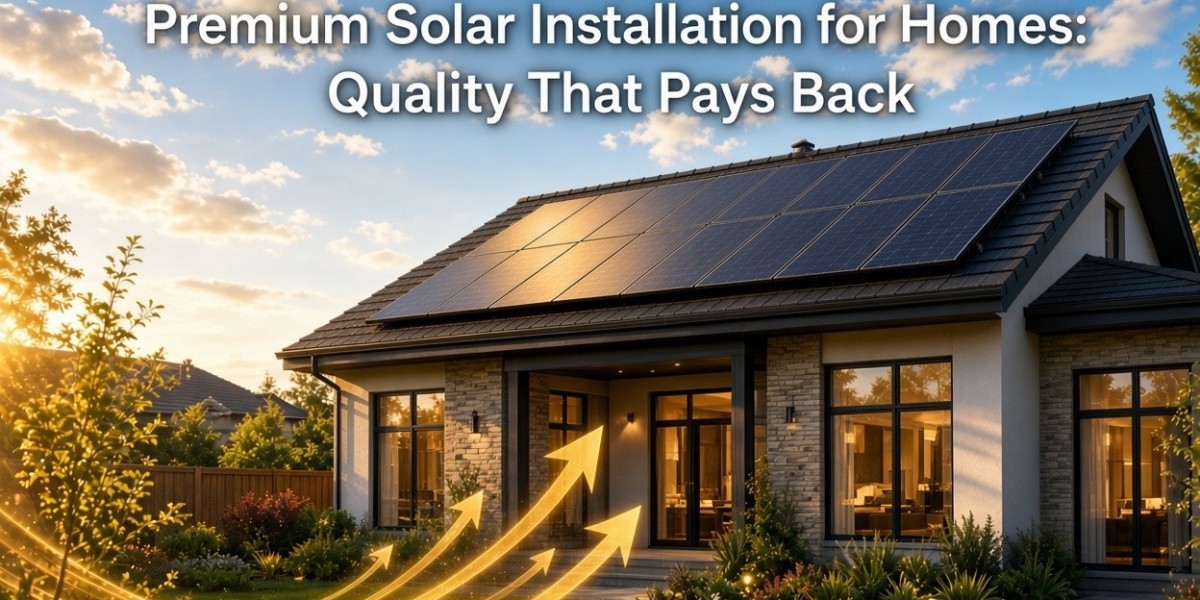

For homeowners considering solar energy, the biggest question is often simple: “Will the investment really pay off?”
The answer depends on more than the number of solar panels installed on the roof. System size, electricity consumption, sunlight, equipment quality, installation workmanship, maintenance and financing can all influence the economics of a residential solar system.
This is where premium solar installation deserves attention.
Premium does not simply mean choosing the most expensive panel or paying a higher installation price. It means taking a complete approach to the project—from property assessment and system design to equipment selection, installation, testing and after-sales support.
For a homeowner, that approach can help turn solar from a purchase based primarily on price into a long-term energy investment.
India's rapidly expanding solar market makes this decision increasingly relevant. The International Energy Agency (IEA) reports that India added almost 50 GW of solar PV in 2025, while global solar PV additions exceeded 600 GW for the first time.
What Makes a Solar Installation “Premium”?
A premium solar installation focuses on the complete system rather than one individual component.
A quality-focused installer should consider:
· Your home's electricity consumption
· Available roof space
· Roof orientation and condition
· Potential shading
· Appropriate solar system capacity
· Panel and inverter selection
· Mounting structure
· Electrical protection and cable management
· System testing and commissioning
· Monitoring and maintenance
· Warranty and after-sales support
In other words, premium solar installation is about getting the important details right before and during installation—not simply choosing expensive equipment.
The Initial Cost vs. Long-Term Value
One of the biggest concerns for homeowners is the initial investment.
A cheaper quotation can certainly be attractive. However, comparing solar systems purely on upfront price can leave out important factors that influence the ownership experience over many years.
For example, two 5 kW systems may have the same advertised capacity but differ in their equipment, design, installation quality, warranty coverage and service arrangements.
The more useful question is:
“What value will I receive from this system over its useful life?”
Solar panels naturally degrade over time. Research reviewed by the U.S. National Renewable Energy Laboratory (NREL) has found degradation rates generally around 0.5%–1% per year, depending on the technology. NREL also notes that higher degradation can increase the lifetime cost of electricity produced by a PV system.
That makes long-term reliability an important part of the purchasing decision.
However, homeowners should be careful about assuming that a more expensive system automatically provides a better financial return. Actual savings depend on factors such as electricity tariffs, household consumption, solar generation, system size, financing and local regulations.
Premium should therefore mean better-informed value—not simply a higher price tag.
Quality Materials Matter
Solar equipment operates outdoors for years, exposed to heat, rain, humidity, dust and changing temperatures.
For this reason, homeowners should look beyond generic descriptions such as “high-quality panels.”
Ask for the exact panel and inverter models included in the quotation.
Then compare:
· Product specifications
· Applicable warranties
· Manufacturer support
· System compatibility
· Availability of replacement parts or service
· Applicable certification or programme requirements
This is particularly relevant when a homeowner is considering government-supported rooftop solar.
The Ministry of New and Renewable Energy (MNRE) states that residential consumers using the applicable rooftop-solar programme mechanisms can receive Central Financial Assistance after successful installation by empanelled vendors and verification by the relevant DISCOM.
For programmes such as PM Surya Ghar, consumers should therefore check the current official eligibility, vendor and documentation requirements rather than relying solely on a salesperson's explanation. MNRE publishes the relevant programme guidelines and updates.
Professional Installation Can Protect Your Investment
Even excellent solar equipment needs a suitable installation.
Imagine a homeowner has a roof with partial shade from a nearby building. If the shading is not considered during system planning, the homeowner may not get the production expected from the system.
Similarly, poor cable routing, unsuitable mounting methods, inadequate electrical protection or insufficient attention to roof conditions can create problems that are difficult to see when the installation is brand new.
Professional installation should therefore include a proper assessment of the property and a system design based on actual site conditions.
The objective is not merely to install panels quickly.
It is to create a system that is safe, maintainable and capable of delivering its expected performance under real-world conditions.
Premium Solar Installation Can Make Monitoring Easier
Another advantage of a well-planned system is the ability to monitor performance.
Monitoring can help homeowners understand whether their system is producing electricity as expected. If generation changes unexpectedly, the information can provide an early indication that something may need attention.
This does not mean monitoring prevents every problem. Rather, it gives the homeowner better visibility into system operation.
That visibility can be particularly useful over a long ownership period.
A quality solar provider should also explain how the monitoring system works instead of simply handing over the equipment after installation.
Warranty and After-Sales Support Matter
Solar panels and inverters can have different warranty terms, and product warranties are not necessarily the same as installation or workmanship warranties.
Before signing a contract, homeowners should ask:
1. What equipment warranty is included?
2. Is workmanship covered separately?
3. Who handles manufacturer warranty claims?
4. What happens if the system stops producing normally?
5. Is maintenance available after installation?
6. What documentation will I receive after commissioning?
These questions may seem less important when comparing quotations, but they can become extremely important if an issue occurs several years later.
A lower-priced installation with limited support may not provide the same ownership experience as a provider that remains available after commissioning.
The Environmental Value Goes Beyond the Electricity Bill
The financial case for solar is important, but there is also an environmental reason to consider a well-designed system.
Solar PV generates electricity without directly burning fossil fuels during operation. As solar deployment expands, it can help displace electricity that would otherwise be generated from higher-emission sources, depending on the electricity mix.
The scale is already significant.
According to the IEA's Global Energy Review 2026, solar PV deployment worldwide avoided approximately 1.5 gigatonnes of CO₂ emissions in 2025.
This does not mean every rooftop system produces the same environmental benefit. The impact depends on factors such as local electricity generation, system performance and the emissions associated with manufacturing and installing the equipment.
Nevertheless, a properly functioning rooftop solar system can contribute to reducing dependence on grid electricity generated from fossil fuels.
A Realistic Homeowner Example
Consider a homeowner who receives two quotations for a rooftop solar system.
Quotation A has the lower upfront price. It provides a basic equipment list but limited information about system design, monitoring, workmanship coverage and after-sales service.
Quotation B costs more. It includes a detailed site assessment, clearly identified equipment, professional installation, system commissioning, monitoring and defined support.
It would be incorrect to claim that Quotation B will automatically produce greater financial savings. There is no universal result because actual solar economics vary by property.
But Quotation B gives the homeowner more information with which to evaluate the total value and potential risks of the investment.
That is the important distinction.
A premium solar decision is not about spending more for the sake of spending more. It is about understanding what you are buying.
How Homeowners Can Make a Smarter Solar Decision
Before choosing a solar installer, use this checklist:
Compare the complete system: Don't compare only the number of panels or total price.
Request exact equipment details: Know the panel and inverter models being proposed.
Ask about site assessment: A professional recommendation should consider your property's actual conditions.
Check warranties: Understand equipment, performance and workmanship coverage separately.
Ask about monitoring: Know how you will track system performance.
Clarify after-sales service: Find out who will support you if something goes wrong.
Verify government-scheme information: Use official MNRE and relevant DISCOM information for current requirements.
Look at lifetime value: Consider expected performance, support and potential maintenance—not only the initial quotation.
Where Solar 365 Fits Into the Decision
For homeowners exploring rooftop solar solutions in India, Solar 365 focuses on services including system design, supply, installation, commissioning and after-sales support.
Its approach can be relevant for homeowners who want to evaluate solar as a complete project rather than simply purchasing panels.
The most important step, however, remains the same for every buyer: compare carefully and ask questions before committing.
Conclusion: Quality Can Be Part of the Payback
A residential solar system is a long-term investment. The financial value comes from the electricity it generates over time, while the environmental value comes from producing renewable electricity and potentially reducing reliance on higher-emission grid generation.
That is why premium solar installation for homes should be viewed as more than a premium price.
The real value lies in careful planning, appropriate equipment, professional workmanship, proper commissioning, transparent warranties and dependable support.
The cheapest quotation may be the right choice in some situations. But homeowners should never assume that the lowest upfront price represents the lowest overall cost.
Compare quality. Compare warranties. Compare installation practices. Compare support. Then compare price.
When the decision is based on the complete picture, homeowners have a much better opportunity to choose a solar system that delivers value for years—not simply a low price on installation day.