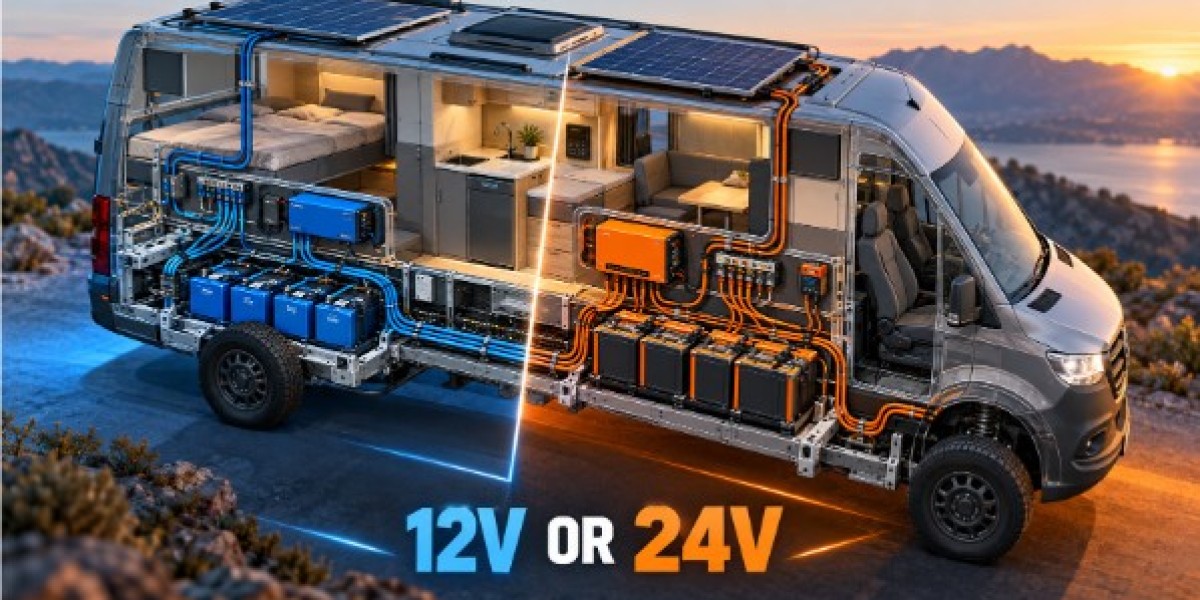

A van builder can choose a battery voltage before buying the rest of the electrical system. An owner upgrading an existing van has a different starting point: the fridge, lights, fans and chargers may already be 12V. Neither situation has one automatic answer. Compare the actual loads and equipment costs before committing to 12V or 24V.
Inventory the van's DC side
Write down the input voltage of every appliance connected to the house battery. Many van lights, pumps and fans are made for a 12V-class system, but do not assume every component is. A 24V bank cannot be connected directly to a 12V load; it needs a suitably specified DC-to-DC converter or a different appliance. The converter becomes another piece to size, protect and maintain.
If the van is already wired for 12V and has modest inverter use, remaining at that voltage may avoid replacing several working components. A new build with substantial AC loads can justify examining 24V earlier in the design.
Why current changes
For the same power, approximate current is power divided by voltage. A 2,000W DC demand is roughly 156A at 12.8V or 78A at 25.6V. Real current varies with voltage and conversion loss. The comparison explains why a higher-voltage bank can reduce current in the main battery-to-inverter path. It does not imply that smaller cables or fuses may be chosen without an engineering calculation.
A 2,000W inverter is an output ceiling, not a claim that every connected device uses 2,000W. List the actual simultaneous loads and their startup behavior. Check the battery's continuous discharge limit and the inverter's input voltage and surge specifications.
Trace every charging route
Shore power may use a converter or inverter-charger. Solar needs a controller appropriate for the array and battery voltage. Vehicle charging needs a DC-to-DC arrangement suitable for the alternator and house system. When the house bank changes voltage, the old 12V charging hardware may no longer be compatible. Include replacement and installation in the comparison.
A system with a 24V bank and 12V vehicle electrical system may need different DC-to-DC conversion than a 12V house bank. The charger's input and output ranges, current and engine-run behavior must be verified. Do not connect unlike-voltage banks through a simple isolator and expect a proper LiFePO4 charge profile.
A decision worksheet
Existing DC appliance voltages and their combined load.
Highest sustained and startup AC inverter demand.
Battery-to-inverter cable length and routing.
Solar, shore and driving charger models.
Physical space for the battery and conversion equipment.
The energy needed between reliable charges.
Amp-hours alone are misleading across voltage classes. A 12.8V 200Ah bank is nominally 2,560Wh, while a 25.6V 200Ah bank is 5,120Wh. Compare watt-hours for storage and amps for current.
Do not let voltage settle the entire bank size
A 24V system can reduce current for a given power, but it does not make a small bank last longer than its stored energy permits. Work out daily watt-hours and reserve independently. A high-power cooktop may be easier to wire at 24V, while a fridge and fans still determine much of overnight capacity.
When considering a lithium battery for RV or van use, compare exact model voltages, output ratings and allowed configurations. RV lithium batteries from Epoch include 12V and 24V choices; the collection helps identify candidates, while the model manuals and existing equipment determine compatibility.
A specific van scenario
Suppose an existing van has 12V lighting, a 12V fridge and a 1,000W inverter used briefly each evening. Its current bank and charging equipment are already 12V. A larger 12V battery with the correct output and charging limits might meet the energy target with relatively little change to DC distribution. But if the owner adds sustained electric cooking and cooling, the inverter-side current and recharge demand rise. That new load profile could make a 24V redesign worth pricing.
The scenario is not a threshold rule. A battery can have enough watt-hours yet an inadequate continuous output limit. Equally, a 24V bank can deliver high power but run out of stored energy quickly. Use the exact appliance and model figures.
The converter deserves a line on the drawing
A 24V-to-12V converter must cover the ordinary combined house loads and any short startup demand. It should have proper input and output protection and a service plan. If it fails, the lights and furnace controls may be unavailable despite a charged 24V bank. Decide whether an essential 12V circuit needs redundancy or a different arrangement, with a qualified installer reviewing the design.
A converter also uses some energy. Include its efficiency and any standby draw in the daily budget, especially for always-on 12V devices. A voltage change undertaken to improve the main inverter path can move losses elsewhere; measuring the total matters.
Decide from the longest cable and largest load
The battery-to-inverter route often carries the highest current. Sketch its actual length, not just the distance on a floor plan. If it is long and the inverter runs large appliances for meaningful periods, the 24V current reduction may simplify part of the wiring. But the final cable and fuse sizes still require calculation under the equipment instructions. A short cable and modest use may reduce the practical difference.
Check future expansion too. An owner planning another roof panel or a larger inverter should include those realistic changes now, while avoiding a system sized for hypothetical appliances that will never be installed. Keep the design grounded in a trip's watt-hours and peak watts.
Before settling on a voltage, price the entire installed system, including a DC converter for existing loads and any charger replacements. Battery sticker prices alone can conceal the cost of a conversion.
The final choice should also leave room for the maintenance and troubleshooting a traveler can realistically manage.
Conclusion
Choose 12V or 24V from the van's loads, inverter demand and charging architecture. A 12V upgrade can preserve existing house circuits; 24V can reduce current in a demanding inverter path but adds conversion where 12V loads remain. Draw the whole system before ordering the battery.