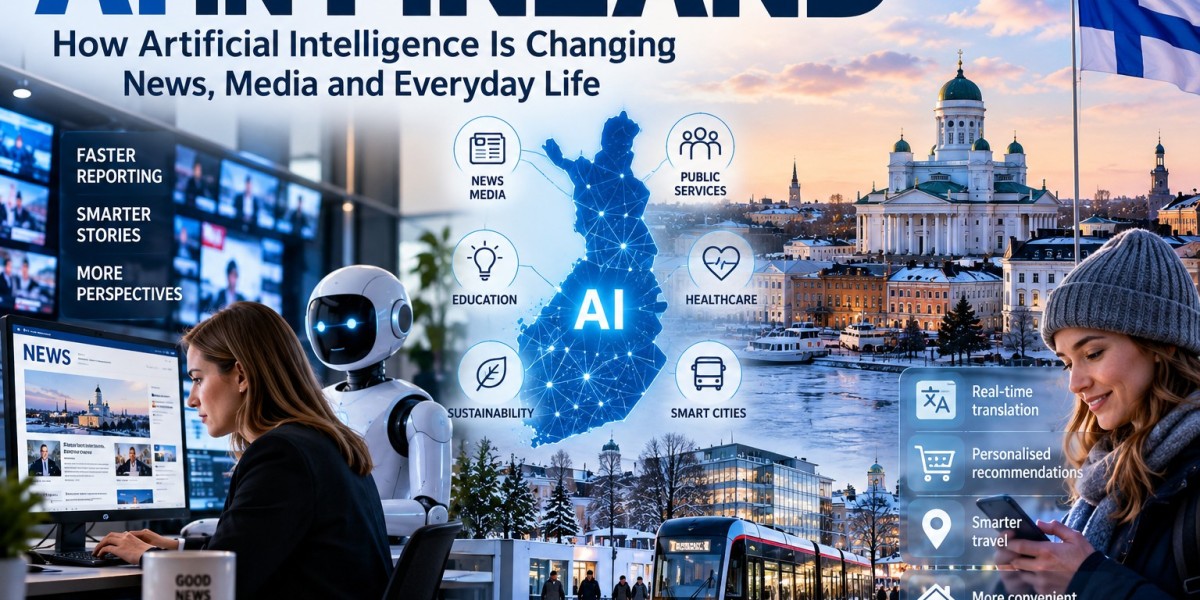

Artificial intelligence is becoming an increasingly visible part of life in Finland. From newsrooms and social media to workplaces and everyday digital services, AI is changing how people create, consume, and understand information.
Finland has long been known for its strong digital infrastructure, technology sector, and education system. As artificial intelligence develops rapidly, the country is facing a new question: how can AI be used to improve everyday life while keeping information reliable and trustworthy?
These changes are particularly noticeable in the Finnish media landscape, where AI is increasingly being used to support journalists, publishers, and digital content creators.
AI Is Becoming Part of Finnish Newsrooms
Finnish news organisations are increasingly experimenting with artificial intelligence.
AI tools can help journalists search large amounts of information, organise documents, create transcripts, translate material, and identify potential stories. These tools can save time when journalists need to process large datasets or large numbers of documents.
However, AI does not remove the need for human journalists. People are still needed to verify information, evaluate sources, decide what is newsworthy, and provide context to readers.
For readers who want to stay updated with Finnish news and current events, following a dedicated Finnish news source can also make it easier to compare online claims with reported information.
AI-Generated News Is Changing Digital Media
One of the biggest changes brought by AI is the ability to produce large amounts of content quickly.
AI can generate summaries, headlines, translations, and other forms of text within seconds. For publishers, this can make some parts of the editorial process more efficient.
However, speed also creates challenges.
AI systems can produce inaccurate information or misunderstand a source. A generated article may look convincing while containing incorrect details. This makes human fact-checking particularly important in journalism.
For Finnish news websites and online publications, maintaining reader trust may become just as important as publishing quickly.
AI-Generated Misinformation About Finland
Another growing concern is the spread of AI-generated content about Finland on social media.
Artificial intelligence can create realistic images, videos, voices, and written stories that appear genuine at first glance. Some misleading posts can use Finland's reputation for technology, education, nature, and high living standards to make fabricated stories appear believable.
A realistic image of a Finnish school or landscape does not necessarily mean that the image represents a real location or event.
This creates a new challenge for internet users. Before sharing surprising content, readers should consider where it came from and whether reliable sources are reporting the same information.
Checking established Finnish news organisations can be a useful way to verify unusual claims.
Why AI Content Can Spread Quickly
AI-generated content can be designed to attract attention.
Posts featuring unusual claims, emotional stories, celebrities, or spectacular images are more likely to generate reactions and shares. AI makes it possible to create this type of content at a much larger scale.
This is especially relevant for social media.
A fabricated quote attributed to a public figure or an AI-generated photograph can circulate widely before anyone has had an opportunity to verify it.
As the technology improves, identifying manipulated content simply by looking at it may become increasingly difficult.
AI and Finnish Social Media
Social media is one of the areas where the influence of AI is easiest to see.
AI tools can help users create photographs, videos, written posts, translations, and even realistic voices. People who have little technical experience can now create sophisticated digital content within minutes.
This has created opportunities for Finnish creators, businesses, and influencers.
At the same time, it can create problems for celebrities and other public figures. Fake images, fabricated statements, or digitally altered videos can be produced without their involvement.
For readers, checking the original source before believing or sharing such content is becoming increasingly important.
AI and Everyday Life in Finland
The influence of artificial intelligence is not limited to journalism and social media.
Finnish consumers already interact with AI-powered technology in many everyday situations. Search engines, translation applications, recommendation systems, navigation services, and digital assistants can all use machine-learning technologies.
AI can also help people write emails, summarise documents, translate Finnish text, learn new subjects, and organise information.
For businesses, artificial intelligence can automate repetitive tasks and help employees analyse information more quickly.
As these systems become more common, AI may become less noticeable as a separate technology and more like an ordinary feature of digital services.
AI and Finnish Jobs
Employment is another major part of the AI discussion in Finland.
Some workers may find that AI changes how they perform their jobs rather than completely replacing their profession.
For example, an employee might use AI to prepare a first draft, analyse data, organise information, or summarise documents before completing the final work themselves.
Other roles may experience more automation, particularly where work consists of repetitive digital tasks.
At the same time, the development of AI is creating demand for skills related to artificial intelligence, data, cybersecurity, automation, and digital systems.
This makes continuous learning increasingly important for workers.
The Importance of AI Skills
People do not necessarily need to become AI engineers to benefit from the technology.
Understanding how to use AI tools effectively, recognise their limitations, verify information, and protect confidential data can be useful across many professions.
Critical thinking is particularly important.
AI-generated information should not automatically be treated as accurate. Users should compare important claims with reliable sources and avoid entering sensitive personal or business information into unfamiliar AI services.
These skills can help people use artificial intelligence while reducing some of the risks associated with the technology.
AI in Finnish Education
Education is another area where AI could have a significant impact.
Students can use AI tools for brainstorming, language practice, explanations, and study assistance. Teachers can also explore AI for preparing learning materials and supporting different learning needs.
However, schools and universities need to address issues such as academic integrity, inaccurate information, and responsible use of AI.
Instead of simply banning every AI tool, education systems may increasingly need to teach students how to use the technology responsibly.
Knowing how to question an AI-generated answer could become just as important as knowing how to produce one.
AI and Finnish Businesses
Finnish businesses are also exploring ways to use AI to improve productivity.
Companies can use artificial intelligence for customer service, data analysis, marketing, document processing, forecasting, and other business activities.
Small businesses may particularly benefit from tools that can automate tasks that previously required significant amounts of time.
However, successful AI adoption requires more than simply introducing new software. Employees need appropriate training, and businesses need policies covering privacy, security, accuracy, and responsible use.
Finland's Position in the AI Economy
Finland has several characteristics that could support continued AI development.
The country has a highly digitalised society, strong educational institutions, technology companies, and research organisations working on advanced digital technologies.
Large technology investments are also drawing attention to Finland's role in Europe's growing AI infrastructure.
Google's major investment in Finnish data-centre and AI infrastructure is one example of the increasing importance of Finland in the European technology landscape.
Such investments can have wider effects on technology, employment, infrastructure, and the digital economy.
The Future of AI in Finland
Artificial intelligence is likely to become increasingly integrated into Finnish society during the coming years.
News websites may use AI for summaries, translations, and other editorial tasks. Businesses may automate more routine processes. Consumers may rely on AI assistants for everyday activities, while schools continue developing approaches to AI-assisted learning.
At the same time, trustworthy information will become increasingly valuable.
As realistic AI-generated content becomes easier to produce, readers may depend more heavily on established sources and professional journalism to distinguish genuine events from fabricated stories.
Final Thoughts
Artificial intelligence is already changing the way people in Finland work, communicate, consume media, and use digital services.
The technology offers opportunities for journalists, businesses, students, researchers, and ordinary consumers. It can save time, process information, and make many digital tasks easier.
However, AI also creates challenges involving misinformation, privacy, transparency, and trust.
For Finnish internet users, understanding how AI-generated content works and learning how to verify information can become an increasingly important digital skill.
As Finland continues adapting to artificial intelligence, the relationship between technology, journalism, social media, and everyday life will remain an important part of the country's digital future.