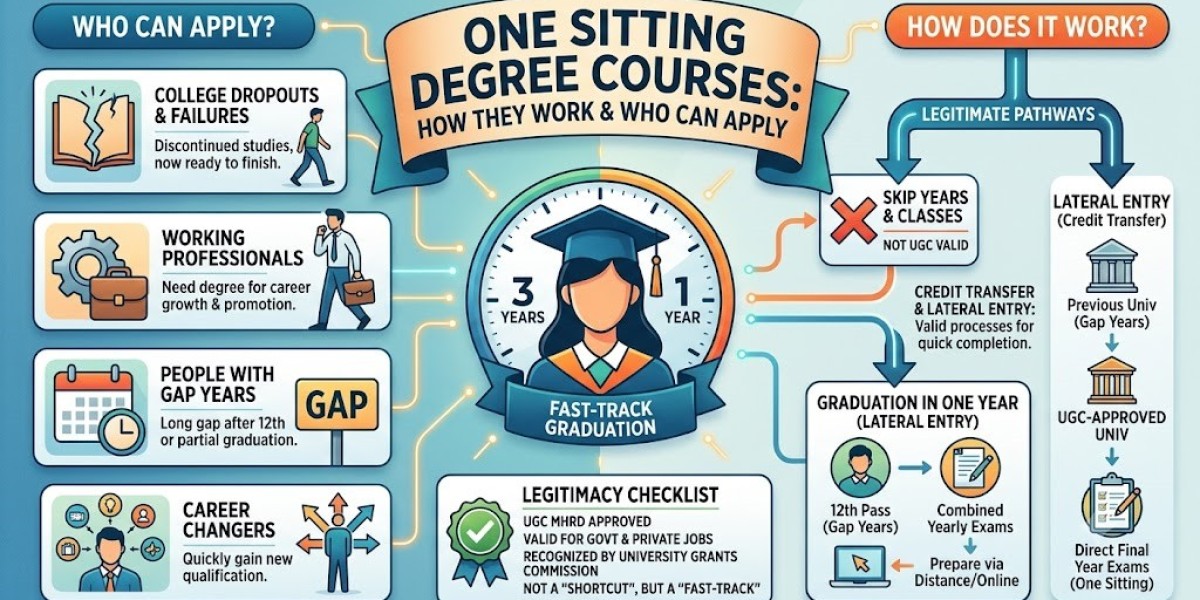

One Sitting Degree Courses have attracted attention among students and working professionals who want to complete pending graduation or postgraduate education within a shorter period. These programmes are often promoted as fast-track, accelerated, or degree-completion options.
However, the term One sitting degree can mean different things depending on the institution and the academic route being offered. Students should therefore understand how these programmes work, who may be eligible, and how to verify recognition before taking admission.
What Are One Sitting Degree Courses?
The phrase one sitting degree is commonly used in the education market to describe a route where eligible learners may complete academic requirements within a shorter or consolidated timeframe.
It is important to understand that “one sitting” is not, by itself, a standard UGC degree category. A programme's validity depends on the university, applicable regulations, admission route, credits or qualifications being recognized, and the mode in which the programme is offered.
Students should therefore avoid assuming that every course advertised as a one sitting degree course is automatically recognized.
How Do One Sitting Degree Programmes Work?
The structure can vary considerably.
Some legitimate academic pathways may allow eligible students to use previously earned credits, qualifications, or recognized learning to complete remaining academic requirements. Other programmes may involve a formal accelerated structure permitted under applicable rules.
However, advertisements that promise a complete graduation or postgraduate degree simply by appearing for one examination should be examined carefully.
Before admission, students should ask:
Which university awards the degree?
What is the exact name of the programme?
What is the approved duration?
What mode of education is being used?
Is the programme recognized for the relevant academic session?
What eligibility criteria apply?
How are credits or previous qualifications considered?
How are examinations conducted?
These questions can help distinguish a properly structured academic programme from an unsupported marketing claim.
Who Can Apply for One Sitting Degree Courses?
Eligibility depends on the specific programme and university. There is no single eligibility rule that applies to every course marketed as a one sitting degree.
Generally, eligibility may depend on a student's previous educational qualifications, completed semesters or years of study, academic credits, or other documented circumstances.
For example, a learner who has previously completed part of a degree may have a different pathway from someone who has never enrolled in a bachelor's programme.
Similarly, postgraduate admission generally requires an appropriate bachelor's qualification.
Students should never rely solely on the phrase “one sitting degree eligibility.” Instead, they should obtain the university's official eligibility requirements in writing.
One Sitting Graduation Courses
Students who have not completed their bachelor's degree sometimes search for one sitting graduation courses such as BA, B.Com, BBA, or BCA.
The availability and recognition of such pathways depend on the institution and applicable regulations.
A student should check whether the university actually offers the relevant undergraduate programme through a recognized route and whether the student's previous education can legally and academically be considered for admission or credit.
A genuine degree-completion route should have a clear academic structure rather than simply promising a degree certificate after a single examination.
One Sitting Post Graduation Courses
Students who have already completed graduation may also search for one sitting post graduation courses, including MA, M.Com, MBA, MCA, or MSc programmes.
Postgraduate programmes have their own eligibility, curriculum, duration, assessment, and recognition requirements.
If a programme is advertised as an accelerated postgraduate degree, students should verify the exact academic framework and whether the accelerated route is permitted under the applicable regulations.
The university awarding the qualification should be clearly identified.
What About Working Professionals?
Working professionals are one of the groups that often explore fast-track education options.
A flexible programme can allow professionals to continue working while completing further education. Distance and online learning can provide flexibility through digital study resources, scheduled academic activities, and remote access to course materials.
However, flexibility does not mean that academic requirements can automatically be skipped.
Professionals should look for programmes with clear admission rules, assessment procedures, academic support, and recognition information.
How to Check Recognition
Recognition is one of the most important factors when considering any one sitting degree course in India.
For programmes offered through Open and Distance Learning or online modes, students should check the relevant UGC/Distance Education Bureau information for the university and programme.
The important point is to verify the specific programme and academic session, rather than relying only on a general statement that a university is “UGC approved.”
UGC-DEB publishes information concerning recognized or entitled Higher Educational Institutions and their programmes under the applicable regulatory framework.
Check the University That Awards the Degree
Before paying any fees, identify the institution that will actually award your degree.
Students should be able to find:
Official university name
Official website
Programme name
Admission notification
Eligibility requirements
Duration
Examination information
Fee details
Recognition information
If an intermediary is handling admission, verify the information directly with the university.
This is particularly important for students searching for fast-track graduation courses, because third-party advertisements may use terminology that does not accurately describe the university's official programme.
Be Careful With “One Exam Degree” Claims
One of the biggest areas of confusion is the phrase “one exam degree.”
A student may see advertisements promising that a degree can be obtained simply by taking one examination.
Such claims should not be accepted without verification.
A recognized academic qualification normally has defined admission, curriculum, assessment, and completion requirements. The exact requirements depend on the programme and applicable regulations.
Therefore, students should ask for official documentation rather than relying on verbal assurances from an admission consultant.
Benefits of a Flexible Degree-Completion Route
Where a recognized and appropriate academic pathway is available, flexible study can offer several practical benefits.
Flexibility
Students may be able to manage education alongside work or other responsibilities.
Career Continuity
Working professionals can continue their employment while pursuing higher education through an appropriate flexible mode.
Academic Progress
Students who have interrupted their education may explore available routes for completing their qualifications, subject to eligibility.
Convenience
Distance or online learning can reduce the need for daily campus attendance, depending on the programme structure.
However, these benefits depend on the specific institution and programme.
What Should You Check Before Admission?
Before enrolling in a one sitting or fast-track programme, use this checklist:
Verify the university awarding the degree.
Check the exact programme name.
Confirm recognition for the relevant academic session.
Read the official eligibility criteria.
Understand the programme duration.
Ask how previous education or credits are considered.
Check the examination and assessment process.
Review the complete fee structure.
Confirm how and where academic support is provided.
Keep copies of official admission documents and fee receipts.
If any important information is unclear, contact the university directly before making payment.
One Sitting Degree vs Regular Degree
A regular degree generally follows a predefined academic structure with a standard duration, semester or annual assessments, and prescribed coursework.
A programme marketed as a one sitting or fast-track degree may have a different structure, depending on the academic route.
The comparison should therefore not be based only on duration. Students should compare recognition, eligibility, curriculum, credits, assessment, academic support, and the qualification awarded.
Is a One Sitting Degree Right for You?
There is no single answer for every student.
The appropriate route depends on your previous qualifications, academic history, career plans, and the specific requirements of the university or employer you are targeting.
If you are considering a one sitting degree course, focus first on whether the programme is officially available to you and whether its qualification meets your intended academic or professional requirement.
Speed should not be the only factor in choosing a degree.
Conclusion
One Sitting Degree Courses are often marketed as a convenient way to complete graduation or postgraduation quickly. However, the phrase itself does not establish whether a particular programme is recognized or academically valid.
Students should carefully verify the awarding university, programme, eligibility, duration, mode of study, examination process, and applicable recognition before taking admission.
For students and working professionals looking for flexible education, recognized distance or online programmes may provide suitable alternatives where they meet the learner's academic needs. The safest approach is to check official university and regulatory information rather than relying solely on promotional claims about “one sitting,” “fast-track,” or “one exam” degrees.